
Guardian TradeBot does not rely on one universal strategy. Different market conditions require different logic, and an important part of the research process is determining which strategy types are suitable for which environments.
Two broad categories of strategy are currently central to the system’s development: reversal strategies and trend strategies.
Reversal strategies
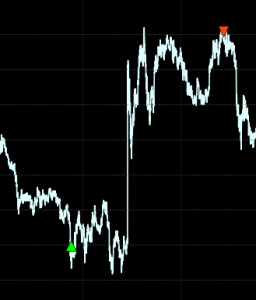
Reversal strategies are designed to identify moments where price has moved too far, too quickly, and may be likely to reverse. These setups aim to capture short-horizon moves back from extremes rather than extended directional continuation.
In practice, this means looking for highly selective entry conditions where price is interacting with defined liquidity areas, volume behaviour is supportive, and the surrounding context suggests exhaustion rather than healthy continuation.
These strategies are especially useful because they can remain effective in conditions where the market is less cleanly directional. They are not perfect, and they are not expected to predict every turning point, but they can be highly effective when designed with strict filtering and disciplined risk control.
Trend strategies
Trend strategies are designed for different conditions. Rather than looking for exhaustion and reversal, they aim to participate in continuation when the market is moving with strength and follow-through.
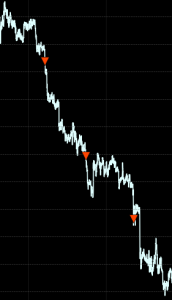
This type of strategy can perform very well in strong directional conditions. However, it can also be vulnerable in choppy or indecisive markets, where continuation signals fail and repeated stop-outs can occur. For that reason, trend strategies require stronger regime awareness and more careful deployment controls than simply generating a signal and executing it blindly.
Why strategy selection matters
One of the central ideas behind Guardian TradeBot is that strategy quality is not only about the signal itself. It is also about where, when, and under what conditions that signal is allowed to operate.
A reversal strategy can behave well in conditions where a trend strategy performs poorly. Equally, a trend strategy can outperform dramatically when the market is cleanly directional. This is why regime awareness and filtering are treated as essential, rather than optional.
The goal is not to force one method to fit every market. The goal is to match the right strategy type to the right environment, and to pause or restrict strategies when the environment is unsuitable.
How indicators are used
Technical indicators are used within the research process and live stack, but not in the simplistic retail sense of treating them as stand-alone buy or sell instructions.
Indicators are used contextually. Their role is to provide supporting information, qualification, and structure around a signal, rather than to act as a single source of truth. Aggregate volume, liquidity behaviour, and market structure are given significant weight in that process.
This matters because many commonly used indicators are derived from price alone. Used in isolation, they often become descriptive rather than decisive. With Guardian TradeBot, indicators are used as one layer within a broader decision framework.
Research and refinement
Strategy development is driven by testing, comparison, and report-based analysis. Multiple configurations can be assessed in parallel, and performance is evaluated not only on gross profitability, but also on consistency, drawdown behaviour, and suitability for live deployment.

An important part of the research process is recognising that small implementation differences can materially affect results. A filter that improves one strategy may reduce the effectiveness of another. A signal that performs well in one regime may fail in another. For that reason, development is selective rather than formulaic.
The objective is not to produce a strategy that wins all the time. The objective is to identify repeatable edges, deploy them under the right conditions, and control losses tightly when they do not perform as expected.
Ongoing development
Current live deployment remains deliberately selective, with focus on the strongest strategies and the cleanest use cases. Additional strategy types, broader regime logic, and further refinements continue to be researched through the internal analysis framework before any expansion in live use.
Over time, this research process is expected to improve both robustness and selectivity, while keeping the system grounded in measured testing rather than narrative claims.